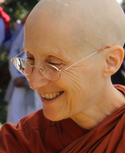
Ayyā Medhānandī Bhikkhunī, is the founder and guiding teacher of Sati Sārāņīya Hermitage, a Canadian forest monastery for women in the Theravāda tradition. The daughter of Eastern European refugees who emigrated to Montreal after World War II, she began a spiritual quest in childhood that led her to India, Burma, England, New Zealand, Malaysia, Taiwan, and finally, back to Canada.
In 1988, at the Yangon Mahasi retreat centre in Burma, Ayyā requested ordination as a bhikkhunī from her teacher, the Venerable Sayādaw U Pandita Mahāthera. This was not yet possible for Theravāda Buddhist women. Instead, Sayādaw granted her ordination as a 10 precept nun on condition that she take her vows for life. Thus began her monastic training in the Burmese tradition. When the borders were closed to foreigners by a military coup, in 1990 Sayādaw blessed her to join the Ajahn Chah Thai Forest Saņgha at Amaravati, UK.
After ten years in their siladhāra community, Ayyā felt called to more seclusion and solitude in New Zealand and SE Asia. In 2007, having waited nearly 20 years, she received bhikkhunī ordination at Ling Quan Chan Monastery in Keelung, Taiwan and returned to her native Canada in 2008, on invitation from the Ottawa Buddhist Society and Toronto Theravāda Buddhist Community, to establish Sati Sārāņīya Hermitage.
The Dhamma, the Buddha's teaching, guides us to a moral awakening, a realization of ultimate truth. We have forever searched for eternal peace in the world of fleeting promises where happiness never lasts. And now we turn to pure conscious awareness, stopping as witness in the silence of the heart. Seeing all as empty, fleeting, free from wanting, free from suffering, we rest in knowing the timeless, boundless, transcendent presence that runs through all things. This is the reality of what we are – unconditional love
Listen to the interior silence with audacious selfless attention and see how pure awareness catapults us into a dynamic intuitive presence. We connect to the Dhamma without obstructions. Silence is formless, soundless, complete. We are witness to an emptiness beyond attachment where the burdens of identification have no footing. There is no 'one' to be in that – for when the intellect bows in faith to the heart, we abide in the loving presence of what is here and now. Ahh! but can we sustain it?
We can't think our way to awakening. How then can we ennoble the heart? Practising right resort will purify the mind with present moment awareness. We give truth a voice, a prevailing knowing reinforced by mindfulness and wisdom. Instead of allowing delusion to rob us of our chance to awaken, we burn it away in its many guises of selfishness, hatred, despair and a host of dark states of mind. Patiently, faithfully, and gently, we navigate the way to true peace, unconditional love, and compassion.
Between beauty and terror lies the Middle Way, at times crushing, at last – transcendent. Can we receive all of life with the pure love of awakened awareness? Just listen and watch in silence. Open and understand the heart in pure presence – the way a valley receives a flood. To witness the truth of impermanence is to know there is nothing at all we can cling to in this vast universe. Rumi wrote, “If you want the moon, do not hide from the night. If you want a rose, do not run from its thorns. If you want love, do not hide from yourself.”
We humans share this journey of birth, old age, sickness and death. Sometimes we succumb to fear or sorrow; sometimes we are exhausted or disoriented as if lost on a perilous path. Seeing this universality of suffering and knowing its causes, we ask: "What will set us free?" With the lens of refined moral aptitude, in silent witness, we stop to listen and directly know for ourselves the inner joy and peace of true harmlessness. Patiently, our noble guides of benevolent compassion and wise reflection steer the heart to its liberation – awakening to Unconditional Love.
Was the Buddha a Buddhist? The Buddha was fully awakened, having realized the truth beyond convention, beyond worldly identities. We want that – to fully awaken; to understand our experience at its core through the purification of the heart. When the mind is completely content within itself, in pure awareness, gone beyond attachment to worldly perception, sensation or gratification, we can know a loving authentic opening to true consciousness, godness itself. We are that.
The human realm is ever fraught with greed and delusion, conflicted and loud in its extremes. These violations are just that – destroyers of our spiritual verve. As pilgrims of peace, we disarm them in the interior silence of the heart. Courageous, we stand our moral ground, resolved to hold the bar. Our faith, generosity and discernment rescue us from the flames of sensory fears and infatuations. There is giving up and letting go but the Buddha’s promise is true. Where kindness and compassion prevail, the heart knows unshakeable peace.
Just as the sun is eclipsed by the moon passing over it, so the mind is submerged in 'totality' due to the veil of our human conditioning. But we can shatter that darkness by diving deeply with moral vigilance and wise attention into the silence of the mind. There we know suffering, how it begins and the exhilarating joy of witnessing its end in the vastness of the heart's inner dimensions. With unshakeable faith, insight, and understanding, we abide in that sacred space of pure awareness and unconditional love – like the sun freed from the shadow of the moon.
Throughout history, hatred, human violence and horrific sufferings have plagued the world. Truth is never diminished by these worldly conditions. So we feed the mind with what supports inner peace and awakening and not with thoughts of depression, disappointment, despair, or fear. What we most fear is unconditional love. That's not consent for nor approval of hateful conduct but rather a call to bear compassion – the most difficult love of all. Like the sun that gives warmth to all beings, the awakened mind does not differentiate. It does not choose one over another. It just gives light
What does it mean to be noble? As a daughter of the Buddha, I learn that no name can confer authority or self-respect, nor does opinion, tradition or entitlement bestow them, for as the Buddha wisely teaches, “One does not become a noble one by birth. It is by one's deeds that one attains to nobility.” Just so, the riches of our human journey are revealed in the fire of inner purification. Therein we find our true name. It is nothing less than the pure presence behind every name – the emptiness in which all personal identity dissolves. And where only unconditional love abides.